
There’s really just one Mavic 2 drone with two camera options. Apart from the camera, the Pro and the Zoom are identical. Both retain the same foldable design as the original Mavic Pro, but they're slightly bigger and heavier now. That’s not what you generally hope for, but what you get in return is considerable: a larger battery with up to 31 minutes of flight time and the ability to travel and track objects up to 45 miles per hour.
Arguably the most-important addition, though, are the new sensors giving the Mavic omnidirectional obstacle avoidance. Not only that, its revamped version of ActiveTrack—now ActiveTrack 2.0—can predict where you’re going to go. The previous incarnation would stop and hover in place if it encountered an obstacle while tracking you; you had to grab the remote and navigate it to safety yourself. With the new version it will encounter, say, a tree branch, then go around it and continue tracking you. It works remarkably well.
The drone maxes out at 12 miles per hour with obstacle avoidance switched on, so you aren’t going to be able to go full-tilt on a mountain bike through a densely-wooded area. Still, I ran in and around some fairly dense trees and bushes and it did a commendable job of staying with me. I was certainly able to lead it into situations it couldn’t get out of, and it would lose me here and there, but it never once crashed. That’s really the key thing here: This is the most crash-proof drone I’ve ever flown, by a long shot. For amateurs, that’s a major selling-point.
In general, the Mavic 2 just feels more polished than the first generation. There’s less wobble in the joints. The lens cover is easier to use and really locks the gimbal in place. Significantly, the remote control seems to have far greater range and throughput. At one point the drone was more than three miles away from me (deep in the wilderness, I promise!) and I still had solid, real-time video coming through with nary a glitch.
One of the new features in the drones is Hyperlapse, which I was very excited about, but which left me underwhelmed. The video is not stabilized, so there’s a fair amount of shake, and it’s limited to 1080p. This feels like a big misstep.
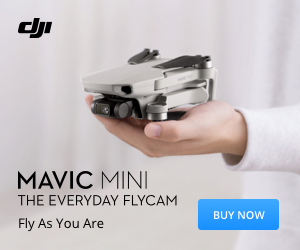
2. DJI Mavic Mini
Another advantage of the Mavic Mini's size is that it can stay in the air longer. The Mini drone features up to 30 minutes of flight time on a full battery charge. The included controller is designed to work with select Android and iOS smartphones (contact DJI for compatibility), letting you easily fly the drone while maintaining a low-latency HD video feed from the gimbal from up to 2.5 miles away. To help you get started, DJI includes a flight tutorial in the DJI Fly app, making the Mavic Mini an ideal drone solution for beginners to professionals alike.